forsyth Station 000 · Expecting rain
A weather mesh / Lower Himalayas, 2026

forsyth.

A scatter of quiet machines that know what the sky is planning.

scroll ↓
The premise

Somebody always knew it would rain.

Every family has one — the relative who glanced at the ridge, said bring the washing in, and was right. No app. No radar. Just a long, unhurried acquaintance with the sky.

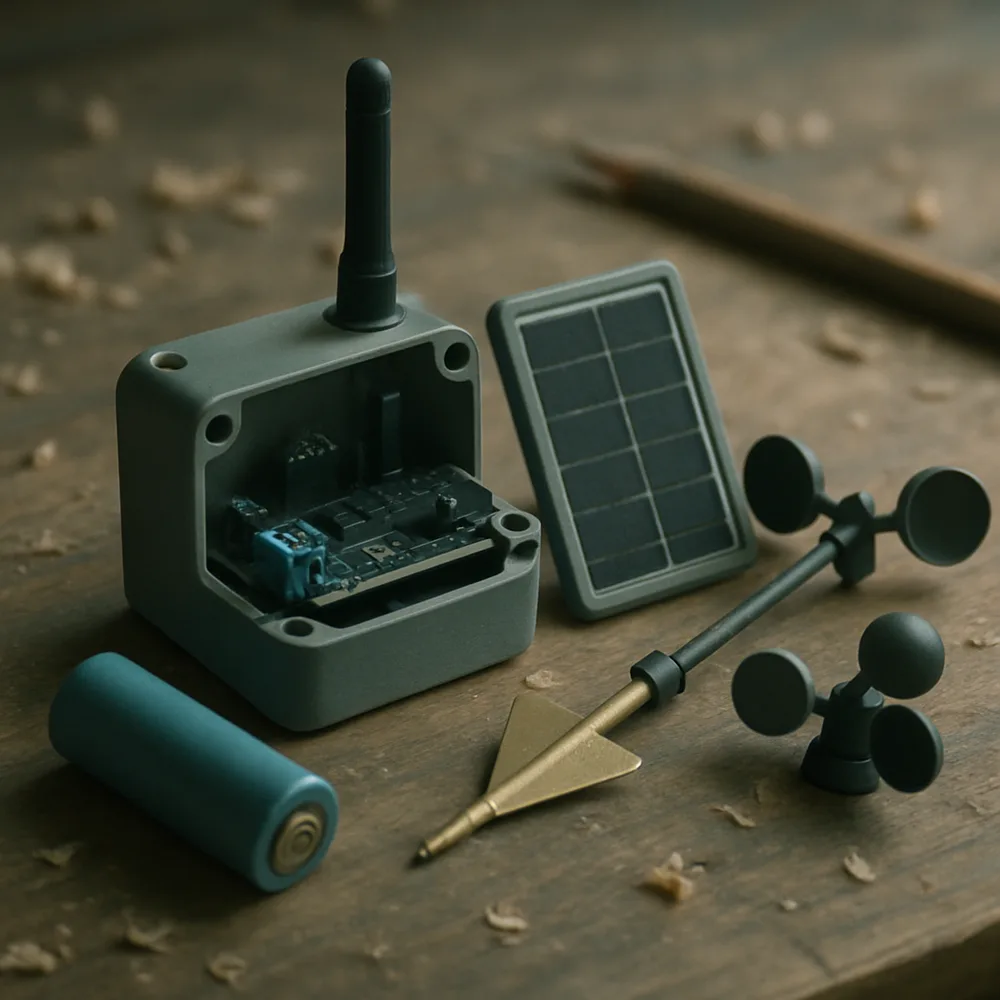
Forsyth is that relative, rebuilt in solder. Small solar-fed stations sit out on masts and rooftops, kilometres apart, measuring wind and rain and pressure and the air itself. A few times an hour each one murmurs what it saw over LoRa radio to a coordinator, which writes it all down and puts it where you can see it.

Say the name out loud. It's not subtle. It is, however, patient about being proven right.
It never says "I told you so." It doesn't have to.

— the flex, unstated
How it works

Four moves, mostly asleep.

  1. 01

    Measure

    A leaf wakes, counts the wind's pulses, reads the air, and notes what the sky has been muttering.

  2. 02

    Speak

    A one-second burst of LoRa, kilometres on a whisper of power. Then the radio is switched off entirely. Not napping — off.

  3. 03

    Gather

    The coordinator hears every leaf, stamps the time, and files it — to your own dashboard and to Weather Underground.

  4. 04

    Know

    You glance at a graph and move the picnic indoors an hour early. Nobody applauds. That's the point.

The senses

Seven ways of paying attention.

  • Wind speed

    A magnet sweeping past a reed switch, counted in hardware while the brain sleeps. Davis has used the same trick for decades; it works.

  • Wind direction

    Eight switches around a circle, read as a single voltage. Three wires up the mast, not ten.

  • Rain

    Counted tip by tip, the same way the wind is counted. Rain is just slower applause.

  • Temperature & humidity

    Its own dedicated sensor, sited to tell the truth — not one that runs warm and flatters the afternoon.

  • Pressure

    The oldest forecast there is. When it falls fast, Forsyth pays closer attention. So should you.

  • The air itself

    A particulate counter spins up its little fan for thirty seconds, takes the air's measure, and goes back to sleep. PM1, PM2.5, PM10.

  • Lightning

    The one sense that never sleeps. A dedicated listener catches strikes up to forty kilometres out, on less current than a wristwatch. Storms rarely arrive unannounced; announcements are usually just ignored.

The arrangement

Leaves, and the one who listens.

A leaf is a station: one small board, a battery that likes being outdoors (LiFePO4), a hand-sized solar panel, and whichever senses that site needs. It spends almost its whole life asleep, drawing microamps, everything switched off between sentences.

The coordinator is the one with an internet connection and, consequently, responsibilities. It listens for every leaf, keeps the clock, and does the talking to the cloud so the leaves never have to.

More ground to cover? Add leaves. A leaf without a rain gauge is still a station; a leaf can grow a new sense later. The mesh is designed to sprawl across a valley, not decorate a single backyard.

The numbers

Four figures, with their units.

Lightning radius
40km
Heard, not seen. Always listening, on microamps.
LoRa reach
~10km
Line of sight, good antenna, clear day. Physics applies.
Solar panel
1–2W
Hand-sized. Enough, because everything else is off.
Radio duty
<1s
Per report. The rest of the time the radio is unpowered.
The lay of the land

Fine machines, all of them.

Forsyth exists in a crowded sky. Here is the field, compared honestly — including the parts where somebody else wins.

Capability Forsyth Davis
Vantage Pro2+
WeatherFlow
Tempest
Ecowitt
Wittboy +
DIY LoRa
builds
Temp · humidity · pressure
Wind & rain sometimes
Lightning detection built in add-on rare
Particulates / AQI built in add-on rare
Kilometres-wide mesh the point house-scale RF Meshtastic
Your data, on your server subscription their cloud local API
Weather Underground
Fixable with a soldering iron sealed
NIST-grade accuracy honest amateur Davis wins
No moving parts reeds, proudly Tempest wins

● yes  ·  ◐ partial, with caveats  ·  ○ no. Full sourcing in the research notes ↗.

A small honesty

There are, at this moment, zero Forsyth stations on any mast anywhere. There is a design, a bill of materials, a power budget, and a workbench in the lower Himalayas where the first leaves will be soldered by hand.

No SKU, no ship date, no promises — beyond this one: when it exists, it will have known about the rain before you did.

Limits

What forsyth can't do.

  • Change the weather. It observes. The sky remains entirely unsupervised.
  • Be surprised. It has strong feelings about surprises. That's the whole product.
  • Say "I told you so." It thinks it, quietly, at 868 MHz.
Family

Part of starstucklab.

A small ecosystem of personal engineering instruments, each built to solve one specific problem and then, ideally, stop demanding attention.

Where science met poetry, had a brief fling with engineering, and now raises mildly disillusioned but talented offspring.